
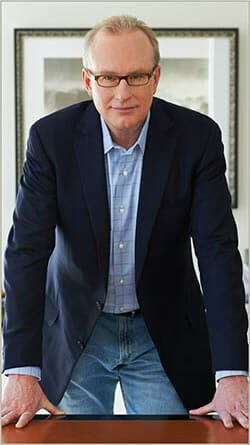
Bill Carmody
PARTNER
With the trial of a generation captivating the nation, ABC News needed an authority on the psychology of juries. Millions of viewers were following the O. J. Simpson murder trial, and ABC wanted to show America how jurors really decide cases. It tracked down a heralded Texas trial lawyer known for his use of mock trials, Bill Carmody, who was busy preparing a long-shot case for a fired employee of a large steel company. ABC filmed Bill’s presentation of the evidence to the mock jurors as well as their deliberations. The network used the footage…and so did Bill. He played ABC’s tape of the mock jury’s deliberations at an eleventh-hour mediation session – and his client walked away with a substantial settlement.
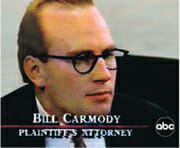
In the decades since, Bill Carmody’s reputation has only grown. Today he is a nationally recognized trial lawyer who tries bet-the-company cases for plaintiffs and defendants in state and federal courts throughout the country. He is a permanent member of Susman Godfrey’s Executive Committee and heads its New York office. Carmody is best known for stepping into big high-stakes trials shortly before they are set to begin and getting paid on his results. He’s described as a storyteller with a “preternatural ability” to connect with juries – and “someone whose core skill set is persuading a lay jury in a complex business case.” Click for press coverage.
RECENT WORK
- In what’s been described as the “tech trial of the century” – the epic clash over self-driving car technology that pitted Google/Waymo against Uber – Bill stepped in shortly before trial to defend Uber. Although Waymo sought damages of almost $2 billion, Bill and his team got all of Waymo’s experts’ damages opinions struck. After Bill’s public and private opening statements and the presentation of four days of evidence to a federal jury in San Francisco, this high-profile case ended in a favorable settlement. Click for press coverage.
- In one of the largest individual claims to be litigated this century, WeWork founder Adam Neumann turned to Bill Carmody as part of a multi-firm trial team after SoftBank withdrew its offer to buy up to $3 billion in WeWork stock from Mr. Neumann and other shareholders. The litigation was placed on an expedited schedule in the Delaware Chancery Court. Days before trial was set to begin, the case settled as reported by The New York Times and media outlets throughout the world. Click for press coverage.
- For General Electric, Bill successfully tried a contract case before a jury in the Southern District of New York, leading to a judgment in favor of GE worth more than $160 million. Click for press coverage.
- On behalf of a pharmaceutical industry whistleblower, Bill and his team prosecuted novel anti-kickback claims in the Novartis qui tam litigation that resulted in total settlements of $465 million – which for a case of its kind is the largest recovery ever. Click for press coverage.
- The City of Baltimore – whose citizens are more likely to die of an opioid overdose than those of nearly any other city in the country – retained Bill and recently filed suit to hold opioid manufacturers and distributors responsible for the harm they’ve done to the city. Click for press coverage.
- On behalf of some of California’s largest political subdivisions that claimed to be overcharged by the “Big 3” wireless carriers, Bill and his team recently secured settlements totaling $175 million. Click for press coverage.
- As co-lead counsel in the nationwide LIBOR antitrust litigation, for Yale University and a class of purchasers of LIBOR-based instruments, Bill and his team have led a fight through the United States Supreme Court to overcome Defendants’ motions to dismiss Plaintiffs’ price-fixing claims, certify a national litigation class, and secure settlements so far with a number of Defendants for $781 million. Click for press coverage.
- Bill and his team won a summary judgment that was upheld on appeal in late 2017 by the New Jersey Supreme Court for Dan Loeb and his hedge fund Third Point in the Fairfax litigation, where plaintiffs sought damages of $8 billion. Click for press coverage.
- In May 2023 Carmody led a Susman Godfrey team that secured a $203 million award on behalf of New York hedge fund legend, Louis Bacon, in his highly publicized defamation lawsuit against Canadian fashion magnate Peter Nygård. This is believed to be the largest defamation award in New York State history.
BET YOUR BUSINESS LITIGATION
Whether representing plaintiffs or defendants, Bill puts his money where his mouth is by betting on his ability to win for his clients. A pioneer in structuring success-based fee deals, he aligns his interests with those of his clients by making his fees dependent on the success he earns – and not on hours billed. Click for press coverage. It’s a creative approach to billing in a profession that doesn’t often stray outside the box.

That’s never been a problem for Bill, whose bold and creative trial tactics have earned the respect of his peers, the media, and legal educators. He has been elected to Law360’s esteemed Trials Editorial Advisory Board in 2019, ’20 and ’21. Carmody previously taught Trial Advocacy at Southern Methodist University School of Law, and served on the law school’s Executive Board. Currently, he serves on the Board of Trustees of The University of Tulsa. He is also a member of the American Board of Trial Advocates, a fellow of the Litigation Counsel of America, and a fellow of the American Bar Foundation.
Carmody’s ranked in the Chambers USA Guide to America’s Leading Lawyers in three departments, including its ranking of Nationwide Trial Lawyers and General Commercial Litigation in New York. According to Chambers:
“Clients call on Bill for big high-stakes matters. He’s the real deal.”
“Bill Carmody is on every client’s shortlist if there is a case to try…A leader, strategist and negotiator. If you want to win, you want Bill on your side.”
“He is a natural leader who has tremendous credibility with judges and juries.”
Clients praise Carmody as a “born trial lawyer,” and highly rate his ability to “swoop into a complicated case, master it, and try it … He can turn complex legal matters into a telling story, and he then finds stories that resonate with the jury.”
“He’s a force of nature: a strategic thinker, a problem solver and hired-gun trial lawyer extraordinaire.”
He is routinely included in Benchmark’s Top 100 Trial Lawyers. According to Benchmark, Carmody is a “universally recognized and nationally hired” trial lawyer, and here is how his peers describe him:
“When you hire him, your metric should not just be ‘How much do I want to win?’ but more ‘How much can I afford to lose?’ If the answer is ‘I can’t,’ you should hire Bill.”
“Of all the lawyers I’ve worked with in all my years, this guy [Carmody] was the best in every respect. As a trial lawyer he could do it all. He’s based in New York now but stylistically was absolutely ‘Texas hot!’ He is just in another league.”
Carmody is listed in The Best Lawyers in America in seven categories, including Bet-the-Company Litigation. He is also listed in Who’s Who Legal in Commercial Litigation. His peers have voted him both a “New York Super Lawyer” and a “Texas Super Lawyer,” and he’s listed in The Legal 500, in addition to being selected among America’s Top 100 High Stakes Litigators by America’s Top 100. Carmody was honored by Law360 as one of its 10 Titans of the Plaintiffs Bar. He is also perennially listed in the Lawdragon 500, the guide to America’s leading 500 lawyers. Lawdragon also lauded him as one of its 41 Legal Legends and inducted him into its Hall of Fame.
Carmody was a top three finalist in 2018 for the New York Law Journal’s Attorney of the Year. In 2019, Lawdragon selected Carmody as one of its Leading Plaintiff Financial Lawyers and The National Law Journal selected him as one of its Masters of the Courtroom – Winning Litigators. In 2021, ’22 and ’23, Benchmark placed Bill on its shortlist – of five to six lawyers – for National Trial Lawyer of the Year.
Carmody appears frequently in national and international media, and his trials have been featured in hundreds of publications, including The New York Times, The Wall Street Journal, The Washington Post, The Financial Times, the San Francisco Chronicle, Business Week, Bloomberg, The National Law Journal, Texas Lawyer, and The American Lawyer. He has been profiled by Lawdragon in its “Producers” series, by Law 360 for its “Trial Pro” series, and by Forbes. While his trial tactics and betting on his clients’ results have received widespread acclaim, most important to Bill and his clients are the victories earned in the courtroom – and following are just a few.
SELECTED CASE BRIEFS
Dare To Be Different
“I’ve dealt with lots of trial lawyers and, by far, Bill Carmody is the best I’ve ever seen.”
In a huge defense victory, Bill orchestrated events outside the lawsuit to defeat a local hero in his hometown court. Carmody’s client, a Dallas investment brokerage, got sued for over $50 million. A loss was sure to break the company. The plaintiff was a “big fish” businessman who had sued Bill’s client in his “small pond,” the little town of Rockport, Texas.
The case stood second on the trial docket. If the first case went as set, Carmody’s case would be bumped for months. A postponement could have cost the brokerage an advantage it had gained during discovery: Although Bill had deposed all of the opponent’s experts, he had shielded his client’s key expert from deposition. So, the opposition was ill prepared for the expert’s trial testimony. If the case was reset, the opposition would be able to depose the expert and erase their disadvantage.

To prevent this, Bill took the unprecedented step of brokering a deal in which his client funded a $180,000 settlement of the first case on the docket. This enabled Carmody’s case to be tried while his client still had the edge. Bill did go to trial and won a resounding take-nothing judgment – and jury debriefing confirmed the deciding role of the key expert’s testimony. Bill’s client also won a counterclaim of almost $700,000.
Despite the plaintiff’s vigorous attempts to overturn the take-nothing judgment, this remarkable victory withstood appellate scrutiny; it was affirmed by both the Corpus Christi Court of Appeals and the Texas Supreme Court. Wowed with Carmody’s results throughout the trial and appellate process, the company’s CEO remarked: “I’ve dealt with lots of trial lawyers and, by far, Bill Carmody is the best I’ve ever seen.” Bill Woodruff, CEO, Wm. K. Woodruff and Co., Dallas, TX.
For media coverage of the brokered settlement, see National Law Journal, February 2, 1998, “Two Texas Litigators Leapfrog to Trial Win.”
David Beats Goliath
“Any firm can supply lots of bodies. I’d rather have just one brain like Bill Carmody’s.”
By uncovering evidence of commercial fraud, Bill helped a small contractor conquer a multi-national conglomerate. This “David v. Goliath” scenario pitted Carmody’s plaintiff client against one of the world’s largest oil companies. The case centered around the defendant’s refusal to pay for refinery construction work performed by the plaintiff in El Paso. But Bill capitalized on then-favorable venue rules to hold the case more than 800 miles away, in Beaumont – where the oil company had recently laid off hundreds of workers.

The case was originally viewed only as a million-dollar breach of contract claim; however, Carmody identified a wholly different type of claim that his client’s previous lawyers had missed. It capitalized on the oil company’s most vulnerable conduct – its reckless disregard for worker safety. The argument was novel: The defendant’s false assurances of safe working conditions inside crude oil towers constituted fraudulent misrepresentations. While the damages of the workers who suffered illnesses were obvious, much less obvious was his client’s fraud damages, in the form of increased workers compensation premiums. After an arduous 2-month trial – featuring a paperless, multi-media presentation, complete with an in-court, full-size model of a quarter section of a crude oil tower – the jury found that the oil company committed fraud and awarded Bill’s client over $61 million.
To cash in on this big verdict, Bill quickly negotiated a substantial confidential settlement on behalf of his client. The client’s reaction to this happy ending? “Any firm can supply lots of bodies. I’d rather have just one brain like Bill Carmody’s.” Jerry Strickland, CEO, AltairStrickland, Inc., Houston, Texas.
See, National Law Journal, February 10, 1997, “The Big Numbers of 1996” and Dallas Business Journal, January 17-23, 1997, “Carmody Firm May be Tiny, but Judgment was Mighty.”
Eleventh Hour Save
“It’s never too late to bring in Bill Carmody.”
In a perfect world, a lawyer would always have unlimited time and resources to prepare for trial. But the world is not perfect and, often, time is not on your side. In a case where he suited up for the defense, Bill demonstrated the experience and guts required to take over and win big at the eleventh hour.
The case arose when a life insurance company was sued in a class action case by 25,000 of its policyholders. The plaintiff class alleged that the insurer had breached the terms of its policies, causing the plaintiffs to be overcharged for their insurance. The class sought $108 million in damages. In this bet-your-company case, a loss could have wiped out the company’s net worth – and forced a shutdown.
The case had been pending for five years, as the insurance company was represented by a large, full-service law firm. But with the make-or-break trial looming, the insurance company decided it needed a proven trial lawyer – someone who made his reputation in the courtroom.

So, just 6 days before trial, the insurer asked Carmody to try the case. Bill quickly learned the case cold, devised the trial strategy, and presented the case during an eight-day jury trial. The jury promptly and unanimously delivered a complete defense verdict – and the case was dismissed. Given a new lease on life, the company heaved a sigh of relief and its General Counsel praised Carmody’s command: “Just six days before trial, most lawyers would have refused to take the case. But Bill Carmody thought of, and seized upon, every tactical advantage. Bill was a clutch performer winning us an incredible trial victory.” Bryan R. Newcombe, General Counsel, Legal & General America, Inc., Rockville, Maryland.
See, The American Lawyer, Sept. 2007, Big Suits, “Beller et al. v. William Penn.”
TRIAL REFERENCES
It’s one thing just to read about the way Bill Carmody tries a case. But the best proof of his unique approach comes from talking to people who have actually seen Carmody at work. The following people are clients who have hired Carmody to represent them, lawyers who tried a case with or against him, and judges who presided over one of Carmody’s trials.
| Clients |
|---|
| Brad Berenson General Counsel TPG San Francisco, CA 415-743-6363 Richard Heyman CEO Seragon Pharmaceuticals San Diego, CA 858-735-4581 Avi Katz Pres./Gen. Counsel Loral Space & Communications New York, NY 212-697-1105 Chris Moore General Counsel Angelo Gordon New York, NY 212-962-2009 Robert Mnuchin CEO Mnuchin Gallery New York, NY 212-861-6269 Bryan Newcombe Gen. Counsel Legal & General America Rockville, MD 301-294-6968 Josh Targoff General Counsel Third Point LLC New York, NY 212-715-3403 |
| Co-counsel |
| Daryl Barger Hartline, Dacus, Barger, Dreyer & Kern Corpus Christi, TX 361-866-8009 Mike Carlinsky Quinn Emanuel New York, NY 212-849-7000 Nancy Chung Sidley Austin New York, NY 212-839-6070 Matthew Dontzin Dontzin, Nagy & Fleissig New York, NY 212-717-2900 Gordon Shapiro Jackson Walker Dallas, Texas 214-953-6059 Johnny Ward Ward & Smith Longview, Texas 903-935-3868 |
| Opposing Counsel |
| Trent Bausch Cline Williams Omaha, Nebraska 402-397-1700 David Beck Beck, Redden & Secrest Houston, Texas 713-951-3700 Josh Dubin Dubin Law New York, New York 212-219-1469 Barry McNeil Haynes and Boone Dallas, Texas 214-651-5000 Daniel Slifkin Cravath, Swaine & Moore New York, New York 212-474-1404 Orin Synder Gibson Dunn New York, New York 212-351-2400 Jeffrey Tillotson Tillotson Law Firm Dallas, Texas 214-382-3040 Charles Verhoeven Quinn Emanuel San Francisco, California 415-875-6600 |
| Judges |
| Hon. William Alsup U.S. District Court San Francisco, California 415-522-2020 Hon. David Godbey U.S. District Court Dallas, Texas 214-753-2700 Hon. Marilyn Huff U.S. District Court San Diego, California 619-557-6016 Hon. William J. Monahan Santa Clara Superior Court San Jose, CA 408-882-2270 Hon. Lorna G. Schofield U.S. District Court New York, New York 212-805-0288 Hon. Ira Warshawsky Supreme Court, Comm. Div. Nassau Co., New York 516-571-3351 |
†Bill has been listed in Lawdragon 500 (Lawdragon Lawyer Profiles and Legal News) since its inception in 2003. Super Lawyers are published in Law & Politics Magazine by Thomson Reuters. Bill was a Texas Super Lawyer from 2003 to 2006 and a New York Super Lawyer from 2008 through 2018. Bill has been listed in The Best Lawyers in America (published by Woodward White Inc.) since 2004.
*Attorney advertising ** Prior results do not guarantee similar future outcomes *** Internet mail is not fully secure or private. Therefore, please do not transmit confidential information via Internet mail. Transmission of information is not intended to and does not create an attorney-client relationship. Please do not assume that your communications sent using Internet mail are privileged or confidential. Please do not send Susman Godfrey any confidential information via the Internet without previously consulting one of our attorneys. ****Nothing on this web page is intended to represent that Susman Godfrey currently represents any partic- ular clients mentioned because matters and client relationships naturally terminate from time to time. Copyright© 2018 SUSMAN GODFREY L. L. P. Attorneys at Law. All rights reserved. Unless otherwise noted in website – Not certified by Texas Board of Legal Specialization.
